

PurgoMalum
Content validator against profanity & obscenity.
About PurgoMalum
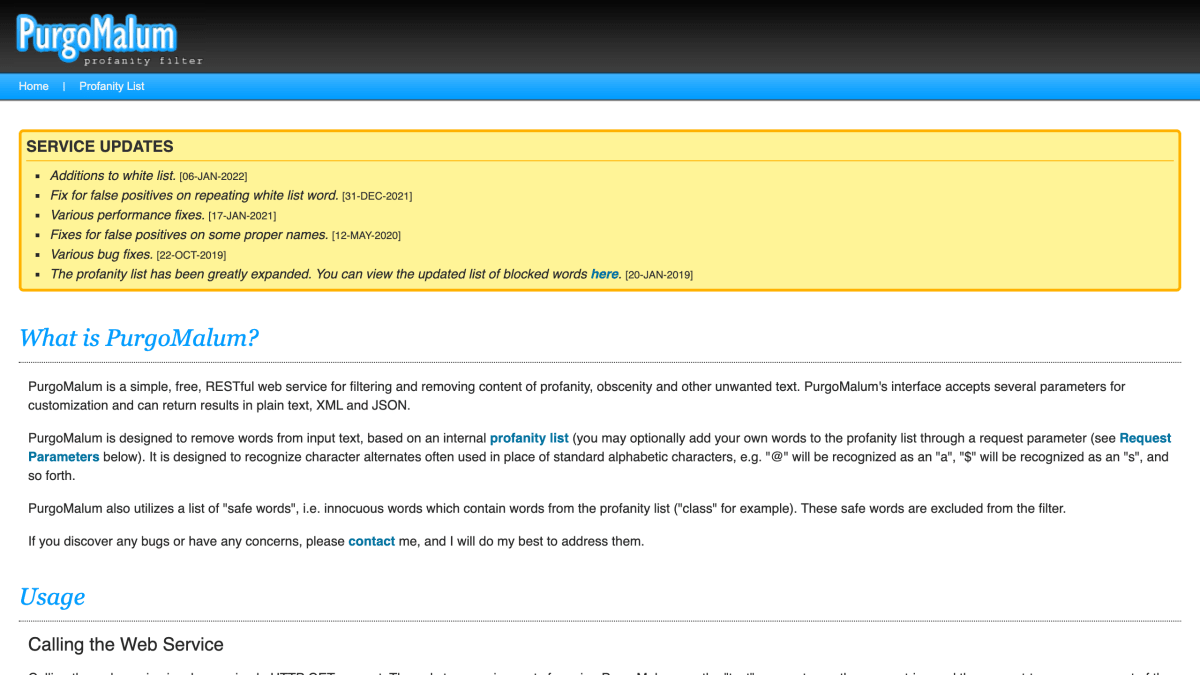
PurgoMalum is a free RESTful web service for filtering profanity, obscenity and other unwanted text from input strings. It works via a simple HTTP GET request with a required "text" parameter, and can return results as plain text, XML or JSON depending on the method called (containsprofanity, xml, json, plain). The filter checks input against an internal profanity list, recognizes common character substitutions (such as "@" for "a" or "$" for "s"), and excludes "safe words" that contain profane substrings but are themselves innocuous (e.g. "class").
The service accepts optional parameters for customization: "add" to append up to 10 additional words (or 200 characters) to the profanity list for a given request, "fill_text" to specify custom replacement text (up to 20 characters) for matched words, and "fill_char" to specify a single replacement character. When no fill option is specified, matched words are replaced with asterisks by default.
This is suited for developers who need to integrate profanity filtering into applications through a lightweight API call rather than implementing filtering logic themselves.
Key features
- Filters profanity and obscenity from text via a RESTful web service
- Recognizes character substitutions like "@" for "a" and "$" for "s"
- Returns results in plain text, XML, or JSON
- Supports custom words added to the profanity list via the "add" parameter
- Customizable replacement text or fill character for filtered words
- "containsprofanity" method checks if text matches the profanity list without filtering it
Frequently asked questions
Is PurgoMalum free to use?
Yes, PurgoMalum is described as a simple, free, RESTful web service for filtering profanity and unwanted text.
How do I make a request to the API?
You make a simple HTTP GET request to an endpoint like /service/xml, /service/json, or /service/plain with a required "text" query parameter.
Can I customize the profanity filter?
Yes, you can add your own words to the profanity list with the "add" parameter and customize the replacement using "fill_text" or "fill_char".
Does it avoid false positives on innocuous words?
Yes, it uses a list of "safe words" (like "class") that contain profanity-list substrings but are excluded from filtering.
What response formats are supported?
The service can return results as plain text, XML, or JSON, and also offers a plain-text "containsprofanity" method returning true or false.


SerpApi - Search API
SerpApi's Search API makes it easy and fast to scrape Google and other search engines.

Show your product to thousands of developers
· 100k monthly pageviews
· 7k newsletter subscribers
You might also like
Lob.com
Data ValidationUS Address Verification.
Nonprofit Check Plus
Data ValidationVerify charities via EIN using IRS, PUB78, BMF & OFAC data for compliance and legitimacy.
Postman Echo
Data ValidationTest api server to receive and return value from HTTP method.
US Autocomplete
Data ValidationEnter address data quickly with real-time address suggestions.
US Extract
Data ValidationExtract postal addresses from any text including emails.
US Street Address
Data ValidationValidate and append data for any US postal address.