


Duply
Generate, Edit, Scale and Manage Images and Videos Smarter & Faster.
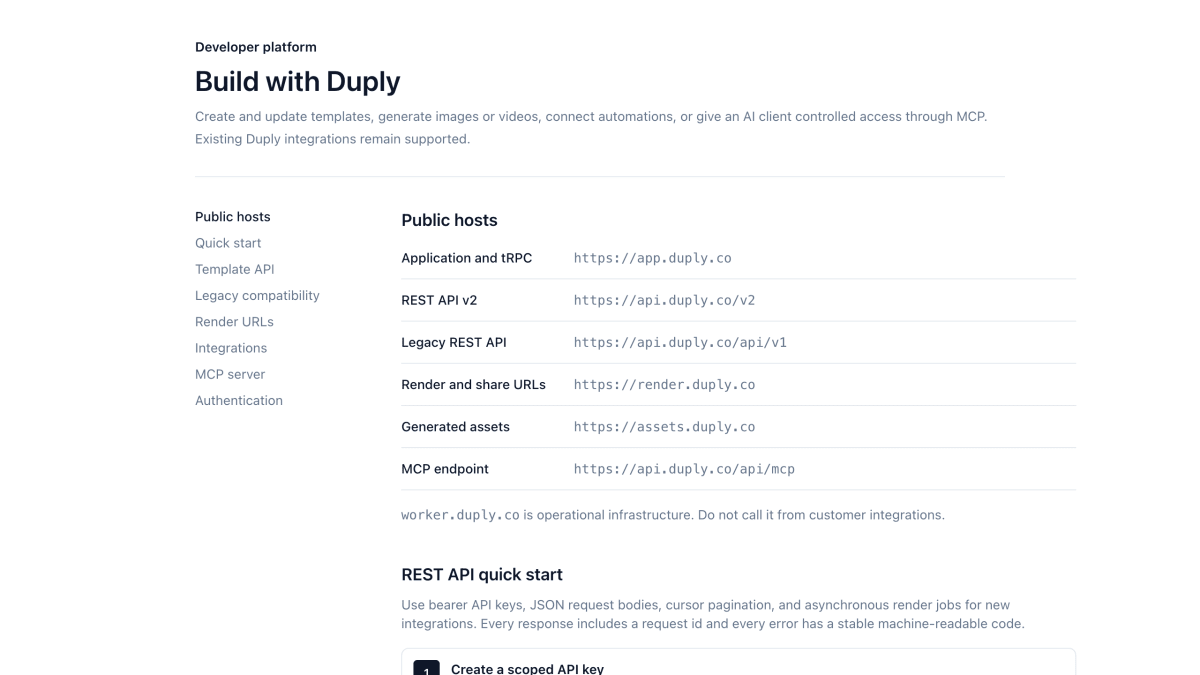
About Duply
Duply is a developer platform for generating images and videos from templates. Templates are created and managed as separate metadata and variant-document resources, with each template supporting multiple variants (sizes or layouts). Content is produced either through asynchronous render jobs submitted via a REST API, or through query-parameter-based render URLs that apply variable values directly to a template before rendering.
The platform offers a REST API v2 using bearer API key authentication, scoped access (templates:read, templates:write, renders:read, renders:write, usage:read), cursor pagination, idempotency keys, and asynchronous job polling, documented via an OpenAPI 3.1 contract. A legacy REST API (v1) and an original API remain supported for existing integrations, including Basic authentication, binary-UUID template identifiers, and prior response formats. Render URLs support format conversion (jpg/jpeg/png), transparency, and both query-based and cryptographically signed access, with edge caching of completed renders.
Duply also exposes a stateless MCP server over Streamable HTTP, backed by the same API keys, scopes, and render queue as the REST API, allowing an AI client to list, inspect, create, and update templates and to create and check the status of renders. Official Zapier and Make apps are available, and the platform documents integration patterns for Zapier, Make, and n8n, recommending the v2 API with idempotency keys for new automation workflows.
Key features
- Generate images and videos from templates via a REST API with async render jobs
- Create and edit templates and variants through the API, including OpenAPI 3.1 contract
- Dynamic render URLs with query-parameter overrides for template fields
- MCP server exposing template and render tools for AI clients over Streamable HTTP
- Legacy API and Basic auth compatibility for existing Zapier, n8n, Make, and custom integrations
- Scoped bearer API keys with idempotency keys to prevent duplicate renders
Frequently asked questions
What integrations does Duply support?
Duply has official Zapier and Make apps, works with n8n via HTTP requests, and supports custom integrations through its REST API.
Can AI clients use Duply directly?
Yes, Duply exposes a stateless Streamable HTTP MCP endpoint using the same API keys and scopes as the REST API, with tools to list, create, and update templates and to create and check renders.
How does authentication work?
New integrations use scoped bearer API keys created in Account, while legacy integrations can keep using Basic authentication and original URLs.
Will my existing integration break if I don't migrate?
No, existing Zapier, n8n, Make, and custom integrations can keep using their legacy endpoints and authentication, though new workflows should use the v2 API with idempotency keys.
How are renders generated and cached?
Renders are asynchronous jobs polled until completion, and identical template, variable, and output combinations reuse the generated file, with completed redirects cached at the edge for five minutes.


SerpApi - Search API
SerpApi's Search API makes it easy and fast to scrape Google and other search engines.

Show your product to thousands of developers
· 100k monthly pageviews
· 7k newsletter subscribers
You might also like
CheetahO
PhotographyPhoto optimization and resize.
Convert Images to PDF API
PhotographyConvert any image to a PDF without losing quality with one API call.
Dagpi
PhotographyImage manipulation and processing.
DynaPictures
PhotographyGenerate Hundreds of Personalized Images in Minutes.
Flickr
PhotographyFlickr Services.
Generate Image Thumbnails API
PhotographyGenerate and optimise Image Thumbnails from any image with this API and save hours of image editing.