
MusicBrainz
Music.
About MusicBrainz
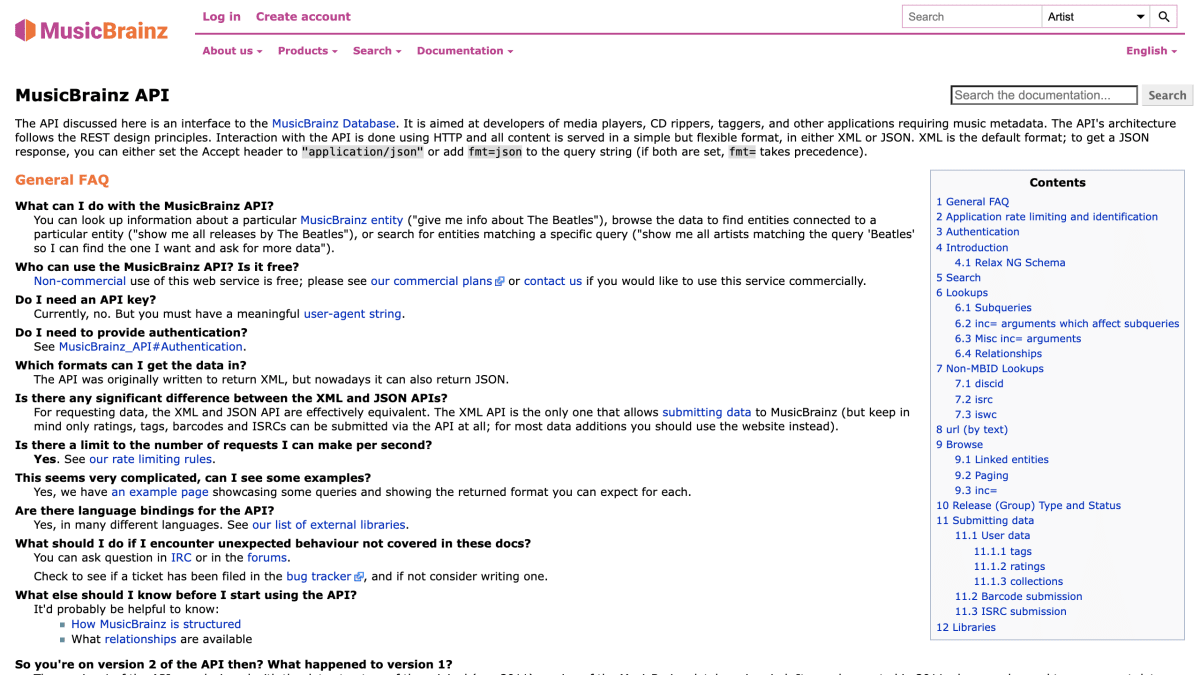
MusicBrainz provides a web service API for accessing the MusicBrainz music metadata database, intended for developers building media players, CD rippers, taggers, and similar applications that need music-related data. The API follows REST principles and communicates over HTTP, returning data in either XML or JSON format (XML by default). It covers core entities such as area, artist, event, genre, instrument, label, place, recording, release, release group, series, and work, plus supplementary resources for ratings, tags, and collections, along with lookups by disc ID, ISRC, and ISWC.
The API supports three main request types on entity resources: lookup (retrieving a specific entity by its MusicBrainz ID), browse (finding entities connected to another entity), and search (querying entities by text, such as an artist name). Data submission is limited to ratings, tags, barcodes, and ISRCs, and is only possible through the XML API; other data additions must go through the MusicBrainz website. Submitting data or making requests involving user information requires authentication via OAuth or digest authentication over HTTPS, though digest authentication is deprecated and scheduled for removal in August 2027.
No API key is required, but each client must send a meaningful User-Agent string and is limited to one request per second; exceeding this limit can result in the client's IP address being blocked. Non-commercial use of the service is free, with commercial use requiring a separate plan arrangement. The previous version of the API (version 1) was deprecated in 2011 and taken down in 2019.
Key features
- REST API for looking up, browsing, and searching music metadata entities (artist, release, recording, label, etc.)
- Returns data in XML or JSON format
- Lookup by non-MBID identifiers: discid, isrc, iswc
- Supports OAuth or HTTPS digest authentication for data submission and user-info requests
- Allows submitting ratings, tags, barcodes, and ISRCs via the API
- Available in many language bindings via external libraries
Frequently asked questions
Is the MusicBrainz API free to use?
Non-commercial use of the web service is free; commercial use requires contacting MusicBrainz about a commercial plan.
Do I need an API key or authentication to use it?
No API key is currently required, but a meaningful User-Agent string is mandatory. Authentication via OAuth or digest authentication is only required for data submission or requests involving user information.
Is there a rate limit?
Yes, client applications must not make more than one call per second, or the IP address may be blocked.
What formats and languages does the API support?
Data can be returned in XML (the default) or JSON, and there are language bindings available in many different programming languages.
Who is the MusicBrainz API for?
It is aimed at developers of media players, CD rippers, taggers, and other applications requiring music metadata.


SerpApi - Search API
SerpApi's Search API makes it easy and fast to scrape Google and other search engines.

Show your product to thousands of developers
· 100k monthly pageviews
· 7k newsletter subscribers
You might also like
LRCLIB
MusicCrowdsourced lyrics.
Mixcloud
MusicMusic.
Mubert AI Music API
MusicIntegrate AI music into your app, game or service.
MusicGPT
MusicAI Music Generator with text-to-speech, voice changer, remix & 20+ music features.
Musixmatch
MusicAccess lyrics, subtitles and music data.
Openwhyd
MusicDownload curated playlists of streaming tracks (YouTube, SoundCloud, etc...).