

Databricks
Manage Databricks workspaces, clusters, jobs, and notebooks via a Rest API.
About Databricks
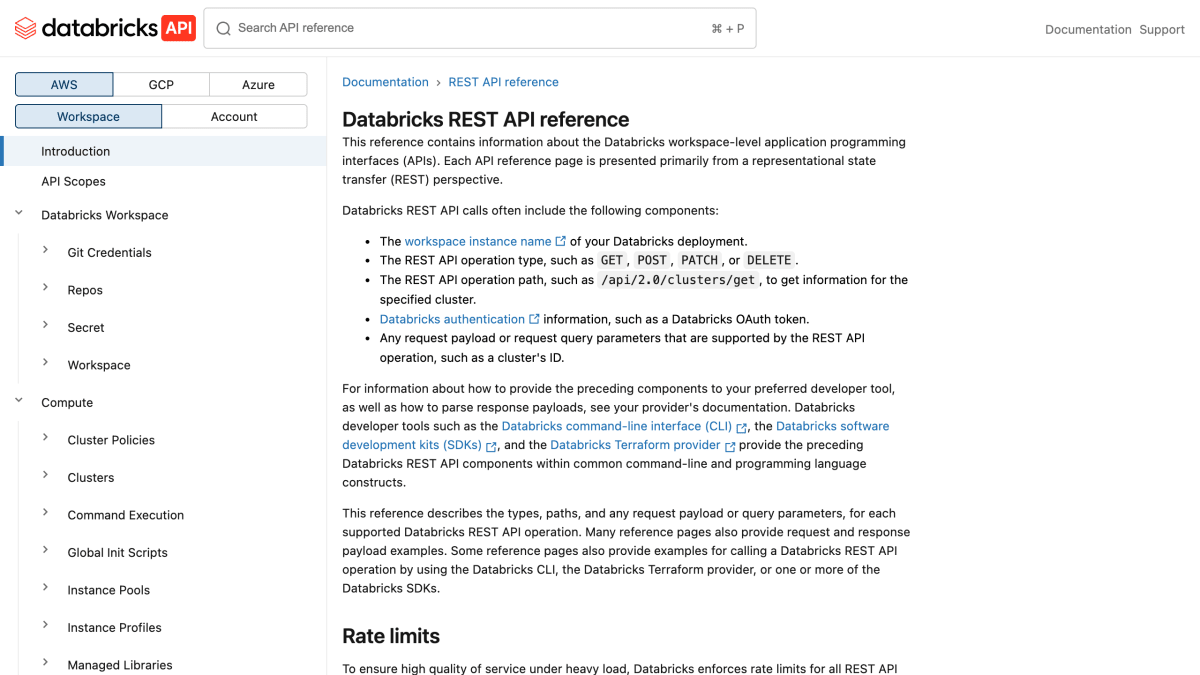
Databricks provides a workspace-level REST API for programmatic access to its data and AI platform. The API is organized around resources including compute (clusters, cluster policies, instance pools, global init scripts), jobs and pipelines, machine learning (experiments, model registry, serving endpoints), Unity Catalog (catalogs, schemas, tables, volumes, credentials, grants), Databricks SQL (warehouses, queries, alerts, dashboards), Delta Sharing, identity and access management, and workspace settings.
Requests follow REST conventions using standard HTTP methods (GET, POST, PATCH, DELETE) against versioned paths such as /api/2.0/clusters/get, scoped to a workspace instance. Databricks recommends OAuth for authentication, supporting both interactive user access and unattended service-principal access, with personal access tokens available as an alternative. Rate limits are enforced per endpoint and per workspace, with excess requests returning a 429 status.
The API is intended for developers integrating with Databricks programmatically, and is also consumed by Databricks' own developer tools, including its command-line interface, SDKs, and Terraform provider. Reference pages document request and response payloads, with examples for some endpoints covering the CLI, Terraform, and SDKs.
Key features
- REST API covering clusters, jobs, pipelines, and workspace management
- Unity Catalog APIs for catalogs, schemas, tables, and permissions
- OAuth-based authentication for both interactive users and service principals
- Databricks CLI, SDKs, and Terraform provider for common language integrations
- Vector Search and Model Serving endpoints for ML workloads
- Delta Sharing APIs for managing data providers, recipients, and shares
Frequently asked questions
What authentication methods does the Databricks REST API support?
Databricks recommends OAuth for both interactive user access and unattended service principal access. Personal access tokens (PATs) are also supported if OAuth is unavailable.
Are there rate limits on the API?
Yes, Databricks enforces rate limits per endpoint and per workspace, and requests exceeding the limit return a 429 status code.
What developer tools integrate with the Databricks API?
Databricks provides a command-line interface (CLI), SDKs, and a Terraform provider that wrap the REST API components into common command-line and programming language constructs.
Which cloud platforms does Databricks support?
The documentation covers AWS, GCP, and Azure deployments.


SerpApi - Search API
SerpApi's Search API makes it easy and fast to scrape Google and other search engines.

Show your product to thousands of developers
· 100k monthly pageviews
· 7k newsletter subscribers
You might also like
Box
Cloud Storage & File SharingFile Sharing and Storage.
ddownload
Cloud Storage & File SharingFile Sharing and Storage.
Delta Lake
Cloud Storage & File SharingOpen-source storage framework enabling Lakehouse architecture with Spark, PrestoDB, Flink, Trino, Hive, and APIs.
Dropbox
Cloud Storage & File SharingFile Sharing and Storage.
Fil One
Cloud Storage & File SharingS3-compatible object storage API (formerly Web3 Storage).
File.io
Cloud Storage & File SharingSuper simple file sharing, convenient, anonymous and secure.