


Harvard Art Museums
Art.
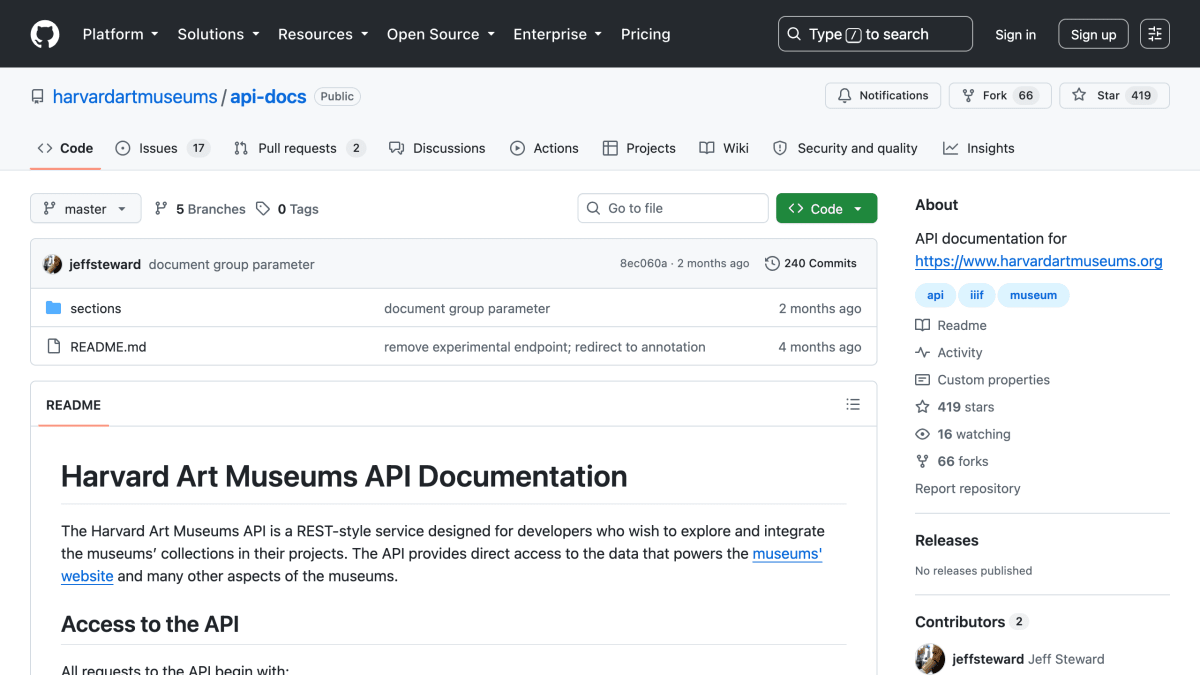
About Harvard Art Museums
The Harvard Art Museums API is a REST-style service that provides access to the data powering the Harvard Art Museums' website and collections. It returns JSON responses and covers resources including objects, people, exhibitions, publications, galleries, classifications, periods, places, mediums, techniques, and worktypes.
Access requires an API key passed as a parameter with each request, and the API returns a 401 error for missing or invalid keys. Responses are paginated, with a default of 10 records per page and a maximum of 100, and support an aggregation parameter based on Elasticsearch aggregation syntax for statistical analysis of the data.
The API also provides access to object images through an IIIF-compliant image service (version 2.1) and a separate IIIF presentation service for manifests. Images of objects with rights restrictions, including many 20th and 21st century works, are excluded for most API users. This service is intended for developers building projects that integrate the museums' collections.
Key features
- REST-style API access to Harvard Art Museums' collections data
- Multiple resource types: Object, Person, Exhibition, Publication, Gallery, and more
- JSON-formatted responses with pagination support (up to 100 records per page)
- IIIF Image API support for retrieving object images at various resolutions
- IIIF Presentation API support for object manifests
- Aggregation parameter for statistical analysis using Elasticsearch-style aggregations
Frequently asked questions
Is there a free tier or pricing?
Access requires a free API key obtained by sending a request; the documentation does not mention any paid tier.
What authentication method does the API use?
Every request must include an apikey parameter with a valid API key, or it returns a 401 Unauthorized error.
What data format does the API return?
All data is returned in JSON format, including an info block, records, and optional aggregations.
Who is this API for?
It is designed for developers who want to explore and integrate Harvard Art Museums' collections data into their own projects.
Does the API support image access?
Yes, images are served through an IIIF-compliant image server (version 2.1) accessible via the baseimageurl and primaryimageurl fields, though images for rights-restricted works are excluded for most users.


SerpApi - Search API
SerpApi's Search API makes it easy and fast to scrape Google and other search engines.

Show your product to thousands of developers
· 100k monthly pageviews
· 7k newsletter subscribers
You might also like
EmojiHub
Art & DesignGet emojis by categories and groups.
Europeana
Art & DesignEuropean Museum and Galleries content.
GetGenAI (Packaging Compliance Review)
Art & DesignCompliance review API for product labels and marketing assets — automated checks against regulations, retailer specs, and brand guidelines, always up to date.
Icon Horse
Art & DesignFavicons for any website, with fallbacks.
Icons8
Art & DesignIcons (find "search icon" hyperlink in page).
Logotypes
Art & DesignLogotypes of the world in multiples format.