


GBIF
Global Biodiversity Information Facility.
About GBIF
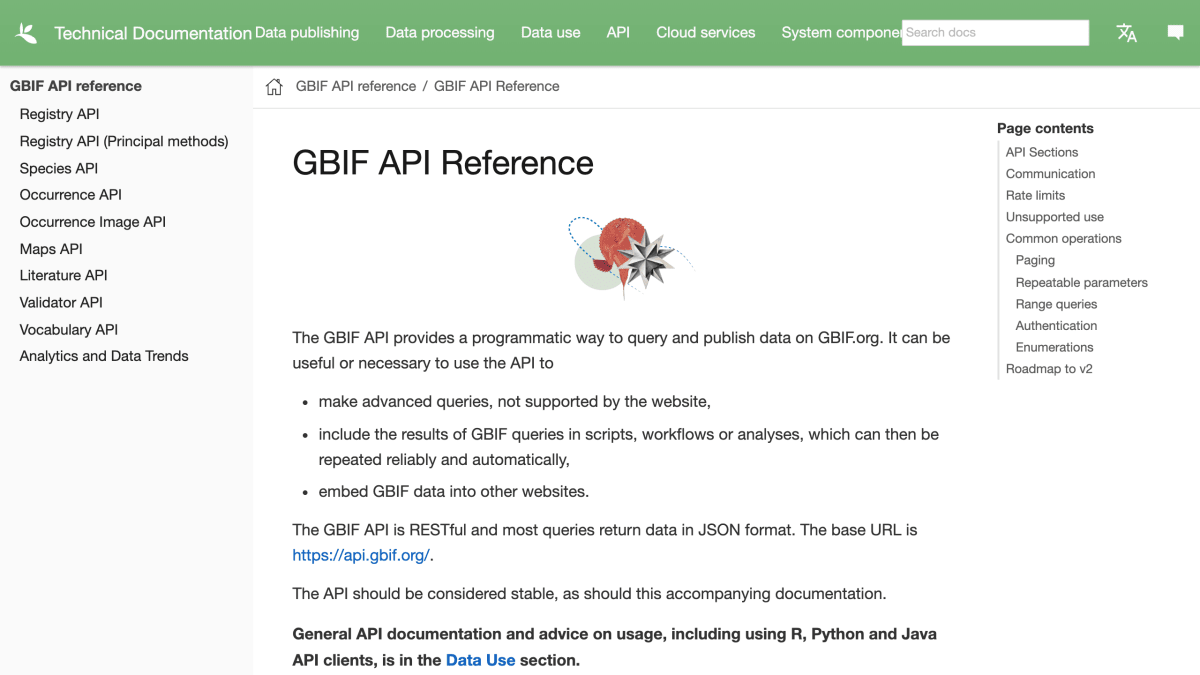
GBIF (Global Biodiversity Information Facility) provides a RESTful API, based at api.gbif.org, for querying and publishing biodiversity data. It returns results primarily in JSON and is organized into sections covering the Registry (datasets, publishing organizations, networks, and access endpoints, also used by the Global Register of Scientific Collections), Species (taxon discovery and name interpretation), Occurrence (real-time paged search and asynchronous batch downloads of occurrence records), an Occurrence Image API, Maps, Literature (peer-reviewed papers citing GBIF datasets and downloads), a Validator for pre-publication data quality checks, and Vocabularies for controlled terms used in data interpretation.
Most endpoints do not require authentication, but POST, PUT, DELETE, and some GET requests use HTTP Basic Authentication with a GBIF user account, for example when programmatically requesting an occurrence download via curl. The API supports paging via limit/offset parameters, repeatable parameters for matching multiple values, and range queries for parameters such as year. Search endpoints may be rate limited (HTTP 429) under server load, and scripts expected to run longer than 15 minutes are advised to use the download API instead, which accepts up to 100,000 search parameters.
The API is intended for developers building advanced queries not supported by the GBIF website, embedding GBIF data into other sites, or automating repeatable workflows and analyses. It is documented as stable under a v1 versioning policy (no removal or renaming of resources, only additions, with advance notice before any future v2 breaking changes), while the Maps API is already at v2. Endpoints not listed in the documentation or marked experimental may change without warning, and scripted use of the www.gbif.org website itself (as opposed to the API) is not supported and may be blocked.
Key features
- Search and download occurrence records with real-time paged search or asynchronous batch downloads
- Species and taxonomy lookup, including name interpretation and identifier matching
- Registry API for datasets, publishing organizations, and networks (including GRSciColl)
- Occurrence Image API for low/medium resolution images linked to occurrences
- Maps API for visualizing GBIF-mobilized content
- Validator for data structure and quality checks before publishing a dataset
Frequently asked questions
Is the GBIF API free to use?
Most use of the GBIF API does not require authentication or payment; authentication is only required for POST, PUT, DELETE and some GET requests using an existing GBIF user account.
What format does the API return data in?
The GBIF API is RESTful and most queries return data in JSON format, with a base URL of https://api.gbif.org/.
Are there client libraries for specific languages?
GBIF provides API clients and documentation for R, Python and Java in its Data Use section.
Is there a rate limit on API requests?
Rapid or numerous queries to search APIs may be rate limited depending on server load, returning an HTTP 429 error, and the download API is recommended for scripts that would otherwise take more than 15 minutes.
Who is the GBIF API for?
It is for developers and researchers who want to make advanced queries not supported by the website, embed GBIF data into other sites, or include GBIF query results in scripts, workflows, or analyses.


SerpApi - Search API
SerpApi's Search API makes it easy and fast to scrape Google and other search engines.

Show your product to thousands of developers
· 100k monthly pageviews
· 7k newsletter subscribers
You might also like
Bootprint
Science & MathRandom facts and images of space.
CodeCogs
Science & MathGenerate LaTeX equations as PNG, SVG, and GIF images.
CORE
Science & MathAccess the world's Open Access research papers.
iDigBio
Science & MathAccess millions of museum specimens from organizations around the world.
inspirehep.net
Science & MathHigh Energy Physics info. system.
isEven (humor)
Science & MathCheck if a number is even.