


Edamam recipes
Recipe Search.
About Edamam recipes
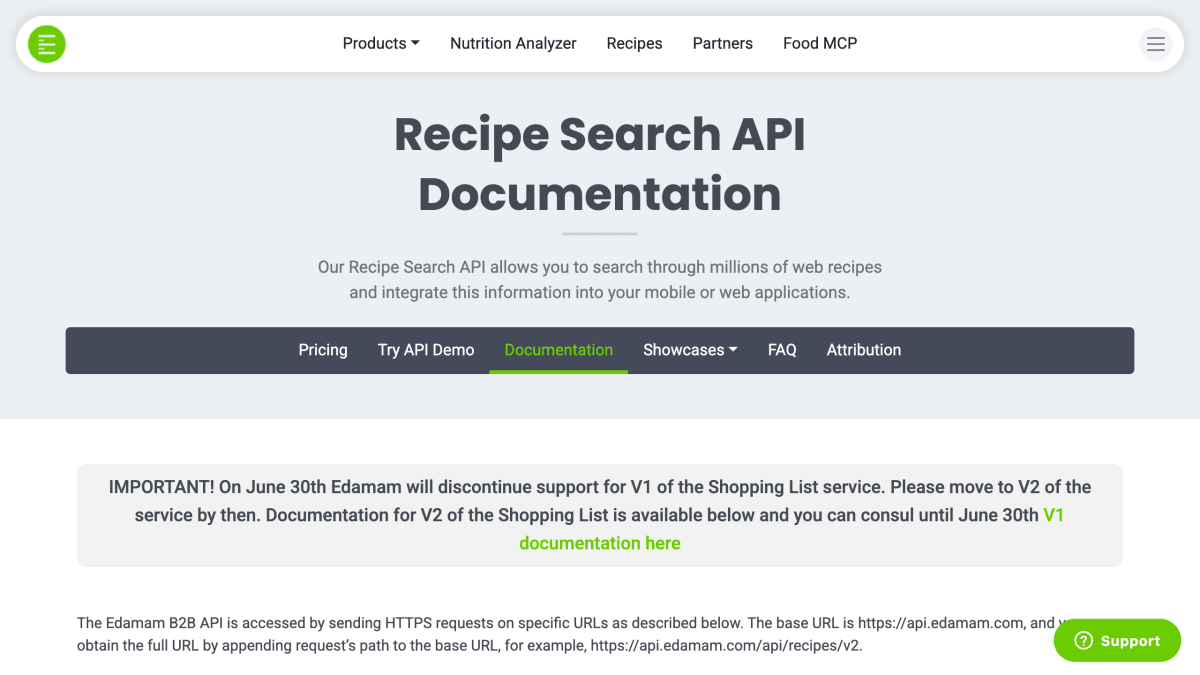
The Recipe Search API provides access to search millions of web recipes for integration into mobile or web applications. Recipes are aggregated from across the internet; the service does not hold copyrights to them and therefore does not provide cooking instructions, only a URL to the source recipe. Nutrition information for each recipe is generated by Edamam. A separate, fully licensed recipe option with cooking instructions is available by contacting the provider directly.
Search results include nutritional data broken down by nutrient (absolute amounts and percent of daily recommended intake), covering categories such as macronutrients, vitamins, and minerals. Recipes can be filtered by available image size (thumbnail, small, regular, or large) and, as a beta feature, by a CO2e emissions rating per serving on a letter scale from A+ to G. The API also integrates with a Recipe Management API for accessing submitted recipes, and with an Edamam Platform Assistant chatbot that translates natural language queries into API calls.
The API is accessed via HTTPS requests to a base URL, supports gzip compression, and includes pagination through a "next" link in the response. An optional Active User Tracking feature is available for the Meal Planner API, requiring app_id configuration and a user ID header with restricted allowed characters. The documentation is intended for developers building applications that require recipe search and associated nutritional data.
Key features
- Search millions of web recipes via HTTPS API
- Auto-generated nutrition information for each recipe, including detailed nutrient breakdown
- Filter recipes by CO2e emissions class (A+ to G rating)
- Filter recipes by available image size (Thumbnail, Small, Regular, Large)
- Pagination support via "next" links in the response
- Natural language querying via the Edamam Platform Assistant chatbot
Frequently asked questions
What does the Recipe Search API return?
It returns web recipes collected from across the internet, including their data and Edamam-generated nutritional information. It does not include cooking instructions since Edamam does not hold copyright to third-party recipes, though it provides a URL to the source.
Does Edamam offer recipes with full cooking instructions?
Yes, fully licensed recipes with cooking instructions are available but must be arranged by contacting Edamam directly.
How is the API accessed?
It is accessed via HTTPS requests to a base URL (https://api.edamam.com) with request-specific paths appended, and an OpenAPI specification is provided.
Can I reduce response size for faster transfers?
Yes, Edamam servers support standard gzip HTTP compression, enabled by sending an Accept-Encoding: gzip header.
What is the CO2e emissions feature?
It's a beta feature (requires beta=true) that lets you search recipes by a CO2e emissions class rating from A+ (lowest) to G (highest) per serving.


SerpApi - Search API
SerpApi's Search API makes it easy and fast to scrape Google and other search engines.

Show your product to thousands of developers
· 100k monthly pageviews
· 7k newsletter subscribers
You might also like
Coffee
Food & DrinkRandom pictures of coffee.
DietlyAPI
Food & DrinkFood & nutrition API with 4.2M+ foods (Open Food Facts + community, normalized and confidence-ranked): calories, macros, micronutrients, barcode lookup, ~40ms s.
Edamam nutrition
Food & DrinkNutrition Analysis.
Foodish
Food & DrinkRandom pictures of food dishes.
Jelly Belly Wiki
Food & DrinkData about Jelly Belly beans- flavores, facts, history and more endpoints.
Kroger
Food & DrinkSupermarket Data.